Healthcare signage in San Diego must simultaneously meet strict ADA compliance requirements, guide patients and visitors through complex campus layouts, and create a professional, calming environment that reinforces trust — all while navigating California’s building codes and the specific signage ordinances of the 18 municipalities across San Diego County. The facilities that execute all three well reduce patient anxiety, decrease front desk inquiries by up to 30%, and avoid the costly ADA violations that result in lawsuits averaging $4,000–$20,000 per occurrence.
Key Takeaways: ADA signage violations are the #1 signage-related lawsuit category for healthcare facilities in California. Effective wayfinding signage reduces patient stress and decreases front desk staffing demands. Healthcare signage must balance regulatory requirements with patient-centered design. San Diego’s healthcare market includes 30+ hospitals and hundreds of clinics with specific signage needs.
ADA Signage Requirements for Healthcare Facilities in San Diego
ADA compliance is not optional for healthcare facilities — it’s a federal requirement under the Americans with Disabilities Act and enforced through California’s more stringent building codes. San Diego healthcare facilities face a dual compliance challenge: federal ADA standards plus California Title 24, which exceeds ADA requirements in several areas.
- Room identification signs: Patient rooms, exam rooms, labs, offices, restrooms, utility rooms.
- Directional and wayfinding signs: Corridor directions, floor directories, department identification.
- Accessibility signs: Accessible entrances, restrooms, parking spaces, elevators.
- Safety and regulatory signs: Exit signs, fire safety, radiation areas, biohazard warnings.
Common ADA Violations in Healthcare Facilities:
- Incorrect braille placement or spacing: California requires specific braille cell spacing that differs from federal standards. Signs manufactured outside California often use federal braille spacing, which fails California inspection.
- Insufficient contrast: Medical facilities often choose subtle, calming color palettes that fail the 70% contrast requirement. Light gray text on white backgrounds is a common violation.
- Wrong mounting location: Signs mounted on the push side of doors, centered above doors, or on the hinge side instead of the latch side. Each location is a separate violation.
- Missing signs for temporary rooms: Even rooms that change function must have proper identification signs.
- Non-compliant digital signage: Interactive wayfinding kiosks must meet accessibility standards for reach range, screen contrast, and audio output. Most don’t.
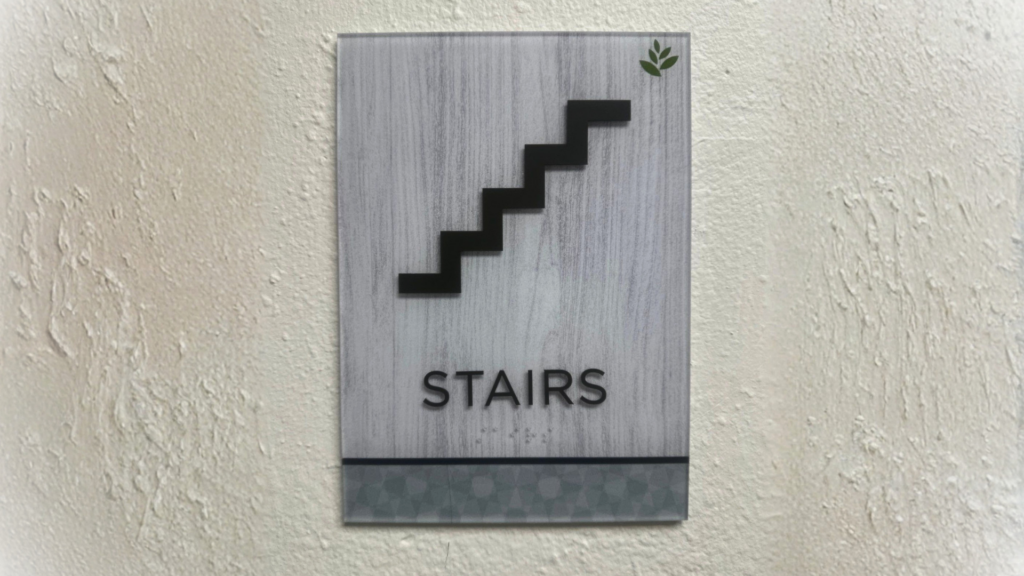
Wayfinding Signage for Healthcare Campuses
Healthcare wayfinding is uniquely challenging because visitors are often stressed, unfamiliar with the facility, and trying to find specific departments in buildings designed for clinical efficiency rather than intuitive navigation. In San Diego’s large healthcare campuses — from Sharp Memorial to Palomar Health in Escondido to Tri-City Medical in Oceanside — effective wayfinding is critical to patient experience.
- Level 1 — Campus Entry and Exterior Navigation: Monument and directional signs at campus entrances, building identification signs visible from parking areas, and parking lot signage directing visitors to the correct building.
- Level 2 — Building Lobby and Floor Directories: Main directory signs in each building lobby, floor and department identification at elevator banks, and color-coded zone identification that maps to the facility’s wayfinding system.
- Level 3 — Corridor Navigation: Directional signs at every decision point (intersection, turn, elevator bank), department identification signs at each entrance, and consistent use of color, iconography, and typography throughout.
- Level 4 — Room and Space Identification: ADA-compliant room signs at every door, logical patient room numbering systems, and staff-only area identification that’s clearly differentiated from patient-accessible areas.
Indoor Signage for Medical Offices and Clinics
Smaller healthcare facilities — dental offices, specialty clinics, urgent care centers — have different signage needs than hospital campuses but face the same compliance requirements.
- Exterior building sign: Identifies the practice and meets zoning requirements.
- Lobby and reception signage: Practice name, check-in instructions, and insurance/payment information.
- ADA room identification: Every exam room, office, and restroom.
- Privacy and compliance signs: HIPAA notices, patient rights, no-cell-phone zones.
- Directional signs: Especially important in multi-tenant medical buildings.
Exterior Signage for Healthcare Facilities
Healthcare facility exterior signs face unique challenges in San Diego County:
Illumination requirements: Hospitals and 24-hour urgent care facilities need illuminated exterior signage for nighttime visibility.
Monument sign regulations: Many cities have specific height and size limits for monument signs in medical/office zones.
Emergency department wayfinding: Clear, illuminated directional signage to the ER entrance is required by most jurisdictions.
Multi-tenant medical buildings: Require tenant signage programs that maintain consistency while allowing individual practice identification.
Frequently Asked Questions About Healthcare Signage in San Diego
What ADA signs are required in a medical office? Every permanently mounted sign identifying a room, space, or feature must be ADA compliant. For a typical medical office, this includes room identification signs, directional signs, and accessibility signs. In California, all signs must include Grade 2 braille with California-compliant spacing, meet 70% contrast requirements, use sans-serif fonts, and be mounted on the latch side of the door at 48”–60” height.
How much does healthcare signage cost in San Diego? A complete ADA signage package for a small medical office (8–12 rooms) typically costs $2,000–$5,000. A full wayfinding program for a larger clinic (30+ rooms) ranges from $8,000–$25,000. Hospital campus signage programs start at $50,000
Can healthcare signage be both ADA compliant and visually appealing? Yes. Modern ADA signage offers a wide range of materials, colors, and finishes that meet compliance requirements while supporting the facility’s design aesthetic. The key is working with a sign provider who understands both the ADA specifications and the design goals.
Do temporary signs in healthcare facilities need to be ADA compliant? Signs that are temporary (less than 7 days) are generally exempt. However, signs that identify permanent rooms or spaces — even if the function of the room changes — must be ADA compliant.
What wayfinding mistakes do healthcare facilities make most often? The three most common: (1) relying on staff directions instead of clear signage; (2) using medical jargon on patient-facing signs; and (3) failing to maintain wayfinding systems after facility renovations, creating dead-end directions and outdated information.
Need Healthcare Signage That Meets Every Code and Serves Every Patient?
All Star Signs produces ADA-compliant signage, wayfinding systems, and exterior identification for healthcare facilities across San Diego County — from small dental offices in North County to hospital campus signage programs.
Contact Us