Monument signs in San Diego work best when they combine street visibility, directional clarity, durable materials, and local code compliance. The right design depends on sight lines, driveway placement, property frontage, tenant needs, lighting, and municipal rules for height, width, colors, and sign content.
Monument signs give San Diego properties permanent street-level visibility
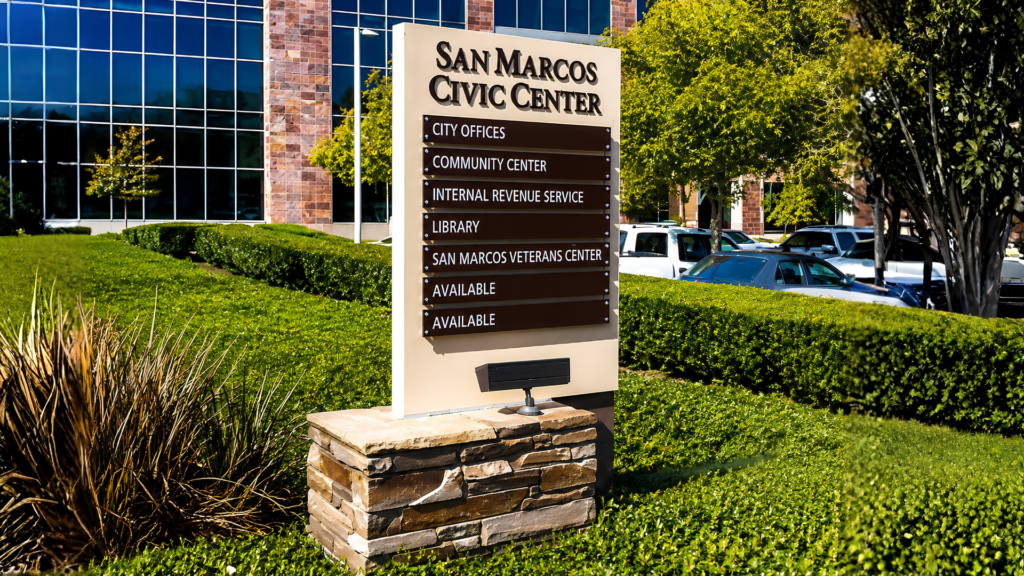
A monument sign is a freestanding exterior sign installed at ground level, usually near a driveway entrance, frontage road, campus entry, business park, school, church, medical office, retail center, or multifamily property. Unlike temporary banners or wall signs, monument signs are built as long-term property identifiers.
For San Diego properties, that permanence matters. Drivers may only have a few seconds to recognize a business name, confirm the address, and decide where to turn. A well-planned monument sign can do three jobs at once:
- Identify the property from the street.
- Confirm the address for visitors, vendors, and emergency access.
- Direct drivers toward the correct entrance, building, or tenant area.
That is why monument signs are common for office parks in Escondido, schools in North County, medical buildings near busy corridors, churches, apartment communities, industrial parks, and commercial centers throughout Metro San Diego County.
All Star Signs has served the San Diego region since 1997/1998 from Escondido, supporting property managers, schools, municipalities, contractors, and businesses with exterior signs, ADA signage, dimensional graphics, and related sign systems.
The best monument sign starts with visibility, not decoration
The biggest mistake is treating a monument sign like a decorative object first. Design matters, but visibility comes before style. If the sign is too low, blocked by landscaping, placed too close to a driveway, or positioned at a poor angle to traffic, even a beautiful sign will underperform.
A practical monument sign planning process should evaluate:
- Street speed and viewing distance
- One-way or two-way traffic approach
- Driveway entry and exit paths
- Pedestrian and vehicle sight lines
- Existing landscaping, walls, slopes, and utilities
- Address visibility from the street
- Daytime and nighttime readability
- Tenant names, suite numbers, or directional arrows
- City rules for height, width, colors, and content
Operator Insight from the All Star Signs Team:
Monument signs are not only for building recognition from the street. They can also serve as directional signs, helping visitors see the address, confirm the business name, and know they are in the correct location. Many customers do not realize the sign must preserve clear lines of sight for people entering and leaving the premises, so monument size and placement must be planned carefully.
That local insight is especially important in San Diego County, where properties often have angled driveways, mature landscaping, shared entrances, sloped lots, and city-specific sign standards.
San Diego monument sign costs depend on structure, materials, and illumination
Most monument signs in San Diego are custom projects, so pricing depends on the property and design requirements. A simple non-illuminated monument panel will cost less than a masonry-style monument with dimensional letters, internal lighting, tenant panels, and engineered footings.
Typical planning ranges include:
| Sign Type | Common Use | Estimated Cost Range | Typical Timeline | Permit Requirements |
| Basic non-illuminated monument sign | Small offices, churches, private businesses | $4,500–$9,500 | 4–8 weeks | Often required |
| Illuminated cabinet monument sign | Retail centers, medical offices, business parks | $8,500–$18,000+ | 6–10 weeks | Usually required |
| Masonry, stucco, or architectural monument | Campuses, HOAs, commercial properties | $12,000–$30,000+ | 8–14 weeks | Usually required |
| Multi-tenant monument sign | Shopping centers, office parks, industrial parks | $10,000–$35,000+ | 8–14 weeks | Usually required |
| Monument sign retrofit or face replacement | Existing structures needing updated branding | $1,500–$8,500 | 2–6 weeks | Sometimes required |
These are realistic budgeting ranges, not fixed quotes. Final pricing can change based on excavation, electrical access, footing requirements, engineering, removal of an old sign, tenant panel count, paint finishes, digital print graphics, or specialty materials.
If your property also needs wall signs, wayfinding, window graphics, or vehicle branding, All Star Signs can help coordinate all signs under one consistent visual system instead of treating each sign as a separate project.
City rules shape monument sign height, width, color, and content
Monument signs in San Diego County are affected by local ordinances. Requirements can vary by city, zoning district, property type, frontage, and sign category. A monument sign in Escondido may not follow the same rules as one in Oceanside, Carlsbad, San Marcos, Poway, or the City of San Diego.
Common review factors include:
- Maximum sign height
- Maximum sign face area
- Setback from property lines or rights-of-way
- Illumination type and brightness
- Allowed colors or materials in certain districts
- Address and tenant content
- Landscaping or architectural compatibility
- Electrical and structural requirements
- Sight triangle restrictions near driveways and intersections
This is where local experience becomes valuable. A national franchise or online-only sign seller may be able to produce a panel, but monument signs require more than fabrication. They require site review, practical placement judgment, durable construction, and coordination with local expectations.
A clear planning process reduces delays and change orders
For most San Diego monument sign projects, the smoothest path follows a structured sequence:
- Site review: Confirm frontage, traffic approach, driveway visibility, utilities, and sight-line constraints.
- Design direction: Choose materials, colors, dimensions, lighting, and whether tenant panels or address numbers are needed.
- Code review: Compare the proposed sign against local monument sign standards.
- Estimate and scope: Define fabrication, removal, installation, electrical work, and any subcontracted work.
- Permit preparation: Submit drawings and required details when applicable.
- Fabrication: Build the sign faces, cabinet, letters, panels, frame, or architectural components.
- Installation: Install footings, structure, electrical components, panels, and final finishes.
- Final inspection and adjustment: Confirm visibility, lighting, alignment, and finish quality.
This process helps prevent costly mistakes, such as designing a sign that is too large for the site, hiding the address behind landscaping, or creating a beautiful monument that cannot be approved as drawn.
Material choices should match San Diego exposure and property image
San Diego weather is easier on signs than many regions, but sun exposure, coastal air, irrigation overspray, heat, and dust still matter. Durable monument sign materials may include aluminum cabinets, acrylic faces, routed panels, dimensional letters, painted aluminum, stucco bases, masonry elements, concrete footings, LED illumination, and high-performance exterior vinyl or print graphics.
For schools, municipalities, and institutional properties, monument signs may need to coordinate with campus wayfinding, marquees for schools], parking signs, and accessibility requirements. For commercial properties, the sign may need removable tenant panels so names can be updated without rebuilding the entire structure.
Quality materials are not just about appearance. They reduce fading, warping, peeling, water intrusion, and service calls.
Local craftsmanship gives monument signs a stronger finished result
A monument sign is one of the first physical impressions a visitor has of a property. It should look intentional, not patched together. All Star Signs brings local San Diego County experience, custom craftsmanship, and a broad in-house service catalog to projects that need more than a generic sign face.
From Escondido to surrounding Metro San Diego communities, the right sign partner should help answer practical questions before fabrication begins: Can drivers read it in time? Does it preserve a safe line of sight? Will the city accept the height? Can the address be seen clearly? Will the sign still look good after years of sun and irrigation exposure?
For property managers, developers, schools, churches, medical offices, and commercial centers, that planning discipline is what turns a monument sign into a long-term asset.
FAQ
Do monument signs in San Diego usually need permits?
Yes, most permanent monument signs in San Diego County require some level of city review or permit approval. Requirements vary by city, zoning, sign size, illumination, and installation method. A local sign company can help evaluate the site and prepare the sign design around applicable rules.
How long does it take to design and install a monument sign?
A typical monument sign project can take 4 to 14 weeks depending on design complexity, permitting, materials, electrical work, and installation conditions. Simple face replacements move faster, while illuminated or architectural monument signs with footings and city review usually take longer.
What is the best location for a monument sign?
The best location is near the main entry or street frontage where drivers can read the sign without blocking driveway sight lines. The sign should make the address easy to find, confirm the property name, and help visitors enter safely without confusion.
Can a monument sign include multiple tenants?
Yes. Multi-tenant monument signs are common for office parks, retail centers, industrial properties, and medical buildings. They can include removable tenant panels, address numbers, directional arrows, and illumination so names can be updated as occupancy changes.
What makes a monument sign more visible at night?
Night visibility usually improves with LED illumination, strong contrast, clean typography, proper letter height, and uncluttered layouts. The goal is not simply to make the sign bright; it should be readable from the correct distance without glare or visual noise.